AmazCart is a Laravel ecommerce CMS sold on CodeCanyon — single-store or multi-vendor marketplace, homepage/mega-menu builders, catalog, checkout, vendor dashboards, marketing tools, and admin reporting. Vendor positioning compares it to large marketplace patterns (Daraz/Amazon-style multi-seller flows).
One client runs it as the online shop front for SparkyPOS — a multi-vendor marketplace (“Unlocking the Future of E-Commerce: Multi-Vendor Marketplace Designed to Work with SparkyPOS!”) with vendor stores, categories, and cart/checkout on AmazCart while in-store sales live in NexoPOS. My work on that stack is API integration troubleshooting between the two systems and minor fixes after a junior developer’s earlier changes — not a greenfield build.
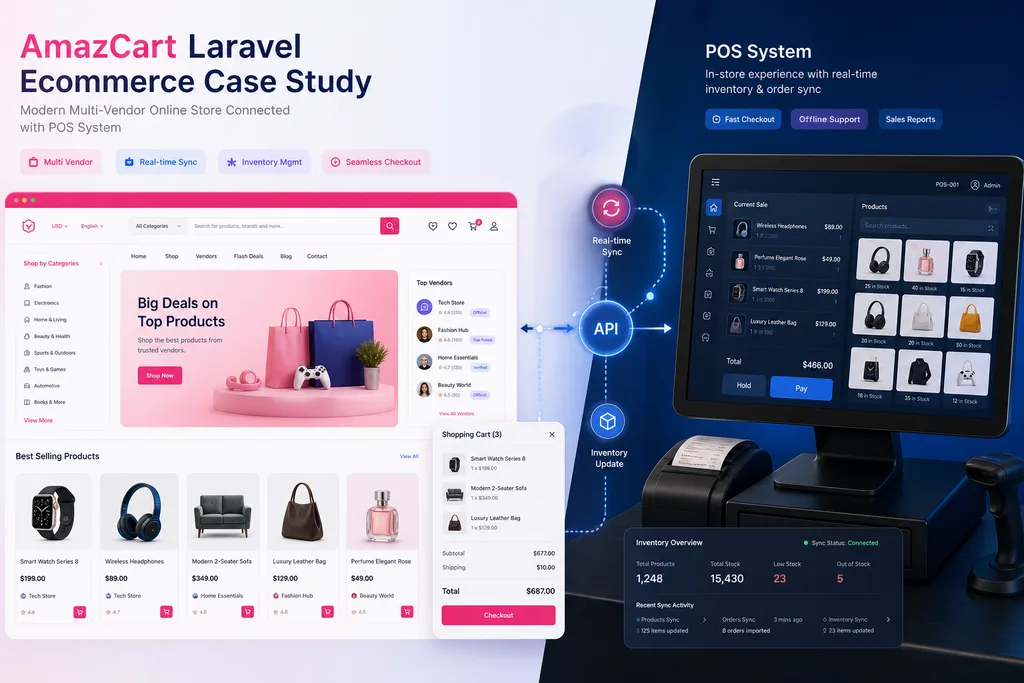
What AmazCart provides (features)
At a high level, AmazCart bundles storefront + CMS + marketplace admin on Laravel:
| Area | Typical capabilities |
|---|---|
| Catalog | Physical & digital products, variants (size/color/style), SKU, galleries, filters, bulk import, multi-level categories |
| Marketplace | Vendor onboarding, vendor dashboards, commissions (including category-wise), trusted seller, multiple sellers per product pattern |
| Storefront / CMS | Dynamic homepage builder, sliders/banners, mega menu, unlimited pages, blog, email templates, AJAX-heavy UI |
| Checkout & orders | Guest checkout, coupons/deals, wishlist, reviews, order tracking, tax/GST, shipping options (flat rate, free, local pickup) |
| Payments & locale | Multiple gateways (PayPal, Stripe, Razorpay, etc.), multi-currency, multi-language (vendor docs cite many languages; active locale is configured per install) |
| Marketing & analytics | Flash deals, new-user zones, social login, GA/GA4, Facebook Pixel, SMS gateway hooks |
| Admin | Roles/permissions, reporting (sales, vendors, inventory), media manager, custom CSS/JS |
For SparkyPOS, the live site shows the marketplace shape in production: vendor-labelled products (e.g. flea-market stores), category blocks, and standard cart flows at shop.sparkypos.com.
Best match use case
AmazCart fits when you want a CodeCanyon Laravel marketplace and accept integration work to connect it to ops tools (POS, ERP, custom APIs).
| Situation | Why this pattern fits |
|---|---|
| Online marketplace + physical POS | AmazCart handles web catalog/orders; NexoPOS (or similar) handles till and stock |
| Multi-vendor flea market / retail collective | Vendor stores and commissions are first-class in AmazCart |
| Already on SparkyPOS-branded stack | Storefront and POS are separate apps — API sync is mandatory, not optional |
| Inherited partial custom work | Integration bugs often surface after junior dev changes — needs senior trace/debug |
Related POS-side notes: /codecanyon/nexopos (dashboard widgets, announcements, and AmazCart API work on the NexoPOS side).
Limitations
Worth planning for before you treat AmazCart + POS as “plug and play”:
- No native NexoPOS coupling — marketplace + POS sync is custom API/integration work; stock, catalog, and order ownership rules must be designed explicitly
- Two Laravel apps to operate — AmazCart and NexoPOS upgrade, queue, and env cycles are independent; drift breaks sync silently
- Multi-vendor complexity — vendor commissions, partial fulfillments, and returns multiply edge cases for any stock bridge
- CMS + catalog overlap — homepage blocks, categories, and product data can fight each other after theme or module edits
- Integration debt — junior or undocumented API patches are hard to debug without mapping both codebases
- Vendor script lifecycle — features and version cadence follow CodeCanyon releases; client installs may lag upstream
TIP
I do not promote buying AmazCart or NexoPOS. This page is case notes from real integration troubleshooting on a client’s SparkyPOS + AmazCart install.
The problem (client engagement)
The client runs AmazCart at shop.sparkypos.com together with NexoPOS for point of sale. A junior developer had started the API integration between ecommerce and POS; when sync issues and small regressions appeared, I stepped in to troubleshoot the bridge and fix minor bugs — auth/payload mismatches, endpoint behavior, and fallout from incomplete handoff rather than a full rewrite.
Typical friction in this class of project:
- Products or stock out of sync between web and till
- API errors only visible under specific vendor/order paths
- Unclear which system owns master data (SKU, price, quantity)
- Partial custom code with no integration test checklist
What I work on (AmazCart + NexoPOS)
On this engagement the focus is integration stability, not rebuilding the storefront:
1. API integration troubleshooting
Trace requests between NexoPOS and AmazCart — endpoints, tokens, payloads, error responses — and align them with the business rules the client expects (what syncs, when, and in which direction).
2. Minor fixes from prior dev work
Clean up small issues introduced during the junior developer’s integration pass: broken handlers, edge-case validation, config mismatches, and UI/admin side effects that blocked reliable sync or checkout.
3. Operational clarity
Document what is fixed vs. still on the roadmap so the client knows when web orders, vendor catalog, and POS stock can be trusted together.
Audit and plan (integration-first)
Before changing either codebase, I map the contract between shop and POS:
- AmazCart + NexoPOS versions and PHP/Laravel env on both sides
- Which entities sync: products, stock, orders, customers (scope per client)
- Master data ownership and conflict rules (web sale vs. in-store sale)
- Existing custom routes/jobs from the junior dev pass
- Repro checklist: create/update product, adjust stock, web order, POS sale, verify both sides
Integration checklist (excerpt)
$audit = [
    'amazcart'  => config('app.version') ?? 'unknown',
    'nexopos'   => config('nexopos.version') ?? 'unknown',
    'targets'   => [
        'catalog_sync' => true,
        'stock_sync'   => true,
        'order_handoff'=> 'scope_per_client',
    ],
    'failing'   => ['api_auth', 'stock_mismatch', 'partial_dev_patches'],
];

return response()->json($audit);
Outcome
The SparkyPOS client keeps AmazCart as the public multi-vendor shop while NexoPOS runs the physical register stack. My contribution is stabilizing the API path between them and clearing minor defects from the earlier integration attempt — so ops are not stuck reconciling two silos manually for every catalog or stock change.
Conclusion
AmazCart is a capable Laravel marketplace CMS, but paired with NexoPOS it becomes an integration project. If you already bought both and sync is flaky — or a junior dev left the API half-wired — targeted troubleshooting beats re-implementing from scratch.
Need AmazCart + NexoPOS API help, sync debugging, or an integration audit? Contact me or see Hire me. NexoPOS-specific widget/API notes: /codecanyon/nexopos.