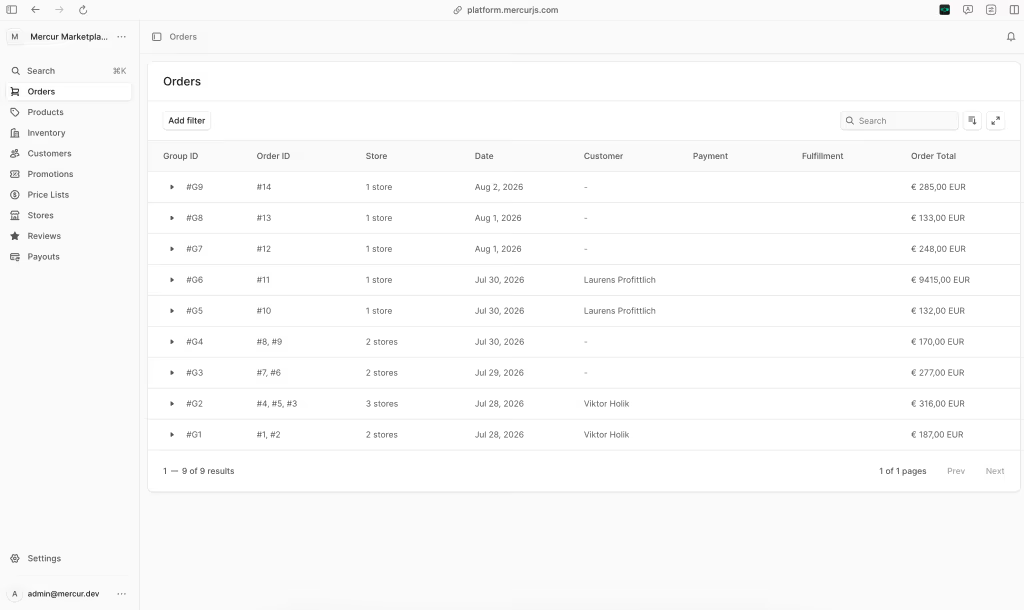
Mercur is an open-source, headless marketplace platform built on Medusa — positioned as a Mirakl-style alternative you can self-host without GMV fees or a locked SaaS runtime. I follow it when the job is real multi-vendor commerce (seller onboarding, shared catalogs with seller offers, commissions, split orders, payouts) rather than bolting “vendors” onto a single-seller cart. The GitHub monorepo, mercurjs.com, features, and v2 docs describe an MIT-licensed core plus optional Enterprise modules, with Admin, Vendor, and Storefront surfaces talking to a TypeScript / Medusa API. Setup for product work is typically bun create mercur-app@latest — clone the monorepo mainly when contributing upstream.
What I like most about Mercur
I keep Mercur on the shortlist when marketplace primitives matter more than another B2C theme — sellers and offers are first-class, not an afterthought plugin.
1. Marketplace domain on a real commerce core
Medusa already covers products, carts, orders, payments, shipping, tax, and stock; Mercur adds sellers, onboarding, product requests/approvals, commissions, reviews, return escalations, order splitting, and vendor payouts (docs intro).
Why it matters: You inherit a battle-tested commerce engine instead of reinventing checkout while still getting multi-vendor behavior.
2. Master catalog + seller offers
Products are shared master catalog items; sellers attach offers (their SKU, price, inventory, shipping) against the same product — the model docs call out explicitly (Offers, Products).
Why it matters: True marketplace assortment (multiple sellers on one product) is different from “each vendor owns a private product tree.”
3. Commissions, split orders, and payouts
Rule-based commissions (flat, percentage, or mixed by site/category/product/seller), multi-seller carts that become order groups with split seller orders, and payout plumbing integrated with Stripe Connect (features, commissions, payouts).
Why it matters: Fee math and money movement are usually the hardest parts of a marketplace build.
4. Operator + seller workspaces
Admin panel for marketplace operators (vendors, catalog, commissions, rules) and a Vendor panel for sellers (catalog/offers, orders, payouts) — plus storefronts for B2C/B2B/hybrid browsing and checkout (site suite, README architecture).
Why it matters: You need three audiences day one: operator, seller team, and buyer — not only a storefront.
5. Block-based ownership model
v2 docs emphasize blocks copied into your project via CLI (not opaque forever-plugins), with workflow hooks, typed clients, and registry/diff tooling for upgrades (welcome, blocks).
Why it matters: Marketplace logic is rarely “config only”; owning source in-repo reduces fork anxiety vs patching a black box.
6. Deployment choice without a proprietary host
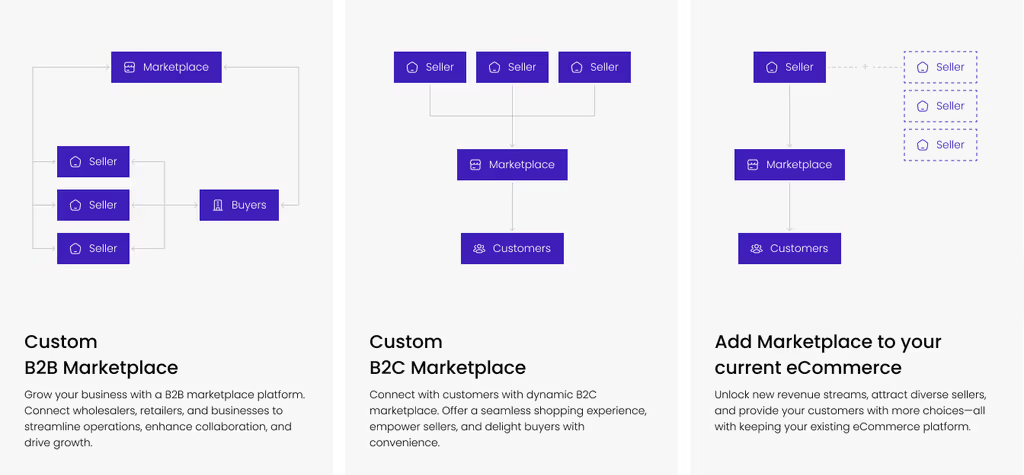
Plain Node.js + PostgreSQL + Redis — containers, K8s, your cloud, or air-gapped; optional Medusa Cloud if you want managed backend. Marketing also describes standalone vs connected marketplace (layer on Magento/Shopify/custom) (homepage, README deployment).
Why it matters: Brands with an existing commerce core often want marketplace as a parallel layer, not a full replatform on day one.
TIP
For a first look: run bun create mercur-app@latest, hit Admin (/dashboard) and Vendor (/seller) with the seeded demo seller, then read installation and the Mirakl alternative note before promising enterprise features that may live in Mercur Enterprise.

Project structure
Product shape (from README + site): independently deployable pieces over APIs.
| Piece | Role |
|---|---|
| Mercur Core | Marketplace engine on Medusa — vendors, commissions, payouts, multi-vendor primitives |
| Admin Panel | Operators manage sellers, catalog, categories, commissions, rules |
| Vendor Panel | Sellers manage products/offers, orders, payouts |
| Storefronts | Buyer-facing B2C/B2B multi-vendor browse, cart, checkout |
| Mercur Connect | Data/integrations layer (imports, sync across systems) — marketed alongside core |
Upstream monorepo (mercurjs/mercur) is the development workspace: @mercurjs/core, React + Vite admin/vendor dashboards, @mercurjs/cli, typed API client, dashboard SDK, Stripe Connect payout provider, integration suites. App projects from bun create mercur-app@latest are the normal path for building a marketplace.
@mercurjs/core layout (from architecture docs):
| Path | Role |
|---|---|
modules/ |
Seller, commission, offer, payout, product-attribute, product-edit, … |
links/ |
Relationships to Medusa entities without mutating core models |
workflows/ |
Multi-step flows (cart split, commissions, payouts, product approval, …) |
| `api/admin | vendor |
subscribers/ / jobs/ |
Event side effects and scheduled work |
providers/ |
Third-party integrations (e.g. payouts) |
API paths: /admin/* (operators), /vendor/* (sellers), /store/* (storefront / checkout with splitting).
Mental model:
- Medusa foundation — catalog, cart, order, payment, fulfillment, events
- Mercur marketplace layer — sellers, offers, commissions, order groups / split orders, payouts, request/approval flows
- Blocks + registry — install/extend features as owned source in your project
- Panels — Admin / Vendor / Storefront consumers of those APIs
# Prerequisites (README): Node.js >= 20.x, PostgreSQL >= 13, Redis; Bun recommended
bun create mercur-app@latest my-marketplace
cd my-marketplace
bun run dev
# Backend API:  http://localhost:9000
# Admin:        http://localhost:9000/dashboard
# Vendor:       http://localhost:9000/seller
# Demo seller:  seller@mercur.dev / supersecret (seeded catalog)
Optional integrations called out upstream: Stripe Connect payouts, Resend email, Algolia/Meilisearch search — credentials in .env when enabled.
Code analysis
Stack snapshot (README, site, monorepo package.json):
| Layer | Technology | Notes |
|---|---|---|
| Commerce core | Medusa (overrides pin ~2.17.x in monorepo) | Products, carts, orders, payments, etc. |
| Language | TypeScript | API-first, event-driven |
| Runtime | Node.js (≥18 engines; README recommends ≥20) + Bun | bun as package manager / create CLI |
| UI | React + Vite | Admin and vendor dashboards |
| Data | PostgreSQL ≥13 | Primary store |
| Cache / jobs | Redis | Required companion service |
| Monorepo tooling | Turbo workspaces | apps/*, packages/*, providers |
| Payouts | Stripe Connect provider | Pluggable payout interface |
| Search | Algolia or Meilisearch | Optional discovery |
| License (core) | MIT | Open core; Enterprise is a separate licensed suite |
Strengths when I evaluate it:
- Real marketplace model — sellers, offers, commissions, split orders, payouts documented as product concepts
- Medusa leverage — commerce primitives you do not rebuild
- Headless / API-first — Admin, Vendor, Storefront APIs for custom UIs
- Block + CLI workflow —
add,codegen,difforiented toward owned customization (and AI-assisted extension per docs) - No GMV fee on self-host core — cost shifts to infra and team, not platform cut
Trade-offs / caveats:
- Not PHP / Laravel — older labels that call it a “PHP script” are wrong; this is a Node/TypeScript/Medusa stack. Plan ops accordingly.
- Open-core — advanced modules (Buy Box, KYC, EAN matching, multi-channel stock sync, etc.) are marketed under Mercur Enterprise; do not assume every feature page item ships in MIT core
- Stack weight — Node, Postgres, Redis, Medusa, and marketplace domain is heavier than a simple CodeCanyon multi-vendor theme
- B2B depth varies by storefront/template — e.g. food wholesale templates (PROKITCHEN) are called out separately; confirm quote/company flows for your vertical
- Team must be comfortable extending Medusa workflows and TypeScript services
Env sketch (illustrative):
# .env — follow the create-app template; names illustrative
DATABASE_URL=postgres://user:pass@localhost:5432/mercur
REDIS_URL=redis://localhost:6379
# Stripe Connect / Resend / Algolia or Meilisearch when those integrations are enabled
Why people use it
| Audience | Why Mercur fits |
|---|---|
| Marketplace founders | Multi-vendor primitives without Mirakl-class SaaS fees |
| Brands adding 3P sellers | Connected model alongside Magento/Shopify/custom (per site) |
| B2B / hybrid operators | Price lists, company-oriented storefront patterns, shared catalog + offers |
| Medusa / TypeScript teams | Marketplace layer on a stack they already ship |
| Self-host / data-control buyers | Own infra, MIT core, no forced proprietary runtime |
Skip it if you only need a single-seller shop, refuse Node/Postgres ops, or need Enterprise-only modules without budget for that tier — a thinner custom Medusa or Laravel path may be clearer.
Conclusion
Mercur is one of the strongest open-source marketplace options I follow on the Medusa ecosystem: sellers, offers, commissions, split orders, and payouts as first-class product — not a B2C cart with a “vendor” checkbox (repo, site, features, docs, resources/blog).
Honest caveat: treat marketing feature lists as platform capability, then verify what lands in MIT core vs Enterprise for your go-live scope. And if an older brief called this a PHP script — correct the architecture assumption before staffing the build.