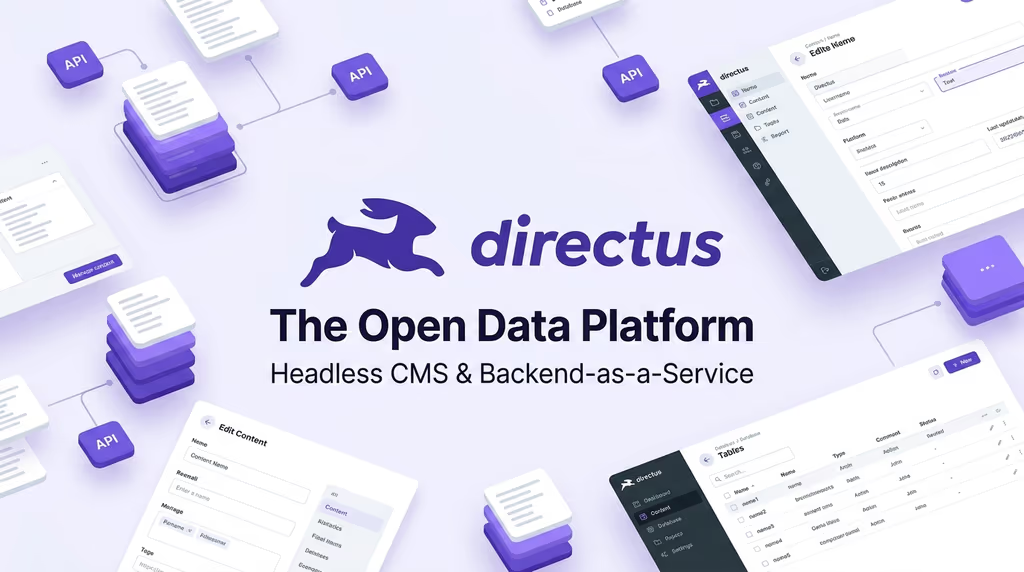
Directus is an open-source, database-first headless CMS and collaborative backend that sits on top of any SQL database. I follow it when I want an admin Studio and instant APIs without locking content into a CMS-specific schema.
What I like most about Directus
I attracted to its clean, modern admin interface and its API-first approach. At the same time, its self-hosting and extensibility make it a great fit for my recent projects. I want to manage multiple website data from one admin panel. All complex setup is done by me in directus and then very light integration is needed in the website code. I have a lot of experience with Directus and it has been a great fit for my projects. Here are its best and most distinctive features, with why they matter:
1. Bring Your Own Database (True Database-First Approach)
Directus wraps your existing SQL database instead of forcing its own schema or data model.
Why it’s great: Extremely low vendor lock-in. Your data stays in standard tables you control. Remove Directus and everything remains intact. Schema is portable via snapshots. This is one of its biggest differentiators versus SaaS-only platforms like Contentful or Sanity.
2. Instant REST + GraphQL APIs (Auto-Generated)
Connect a database and you immediately get fully documented REST and GraphQL APIs with strong parity, deep relational filtering, and (in recent versions) better JSON querying.
Why it’s great: Zero boilerplate. Developers get production-ready endpoints right away. Relational data can be fetched in a single call. Real-time support via WebSockets and GraphQL subscriptions is also available.
3. Best-in-Class Granular Permissions (Policy-Based Access Control)
Collection-, field-, and row-level permissions with custom filter rules, IP allowlisting, default value injection, SSO (OAuth2/OIDC/LDAP/SAML), and 2FA. The same policies apply to both humans and AI agents.
Why it’s great: Reviewers consistently rate this among the strongest permission systems in the headless CMS space. It scales from simple roles to complex enterprise governance without becoming brittle.
4. Native AI Assistant + MCP Server
- Built-in AI Assistant inside the Studio (multi-provider: OpenAI, Anthropic, Gemini; BYOK).
- Native Model Context Protocol (MCP) server so tools like Claude, Cursor, ChatGPT, or any MCP client can talk directly to your live data.
- Multimodal support (images/PDFs), content-aware actions, AI-assisted translations, and full activity logging of AI actions under the same permission model.
Why it’s great: AI works on live data (not a copy), respects existing permissions, and requires no custom middleware. This positions Directus as one of the strongest “AI-ready” backends currently available.
5. Visual Data Modeling + Powerful Studio
No-code/low-code data modeling interface, 35+ field types, conditional fields, custom layouts (Table, Cards, Kanban, Calendar, Maps, etc.), visual editor with live preview, collaborative editing (real-time presence + field-level locking), draft/publishing workflows, and versioning.
Why it’s great: Non-technical users can manage content and data effectively while developers retain full control of the underlying schema. Whitelabeling, multi-language Studio, and role-specific interfaces make it team-friendly.
6. Flows (Visual Automation Builder)
Low-code workflow engine: triggers on data changes, schedules, webhooks, or manual runs. Supports conditions, operations, custom JavaScript, and external service connections.
Why it’s great: Automates repetitive tasks (notifications, integrations, content pipelines) without writing full backend code. Complements the APIs and hooks system.
7. Extensibility + Self-Hosting Flexibility
Custom endpoints, hooks, interfaces, modules, themes, and an extensions marketplace. Fully self-hostable (Docker, Node) or available on Directus Cloud.
Why it’s great: You can bend it to almost any use case (CMS, BaaS, PIM, internal tools, admin panels) while keeping control of infrastructure and costs.
Other Strong Supporting Features
- Digital Asset Manager with on-the-fly transforms, focal points, folders, and S3-compatible storage.
- Insights (no-code dashboards).
- Activity log + revisions for full audit trails.
- Import/export (CSV/JSON), soft deletes, bulk operations.
- Real-time collaboration and deployments module (e.g., triggering Vercel/Netlify builds with role-based access).
Project Structure
Directus is organized as a pnpm monorepo. The main repository (directus/directus) contains everything needed to run and extend the platform.
Root-level layout (high level):
| Folder | Purpose |
|---|---|
api/ |
Backend engine (REST + GraphQL + WebSockets) |
app/ |
Data Studio (admin UI) |
directus/ |
Main CLI / distribution package |
sdk/ |
Official TypeScript/JavaScript client |
packages/ |
Shared libraries & utilities (35+ packages) |
tests/ |
Platform-wide tests |
Key packages inside the monorepo:
@directus/api— Node.js backend@directus/app— Vue 3 Data Studio@directus/sdk— Client library@directus/schema,@directus/utils,@directus/types,@directus/storage,@directus/extensions-sdk, storage drivers (S3, GCS, Azure, local, etc.), memory/Redis abstraction, and more
Architecture overview:
- Directus sits on top of any SQL database. It introspects the schema and dynamically generates APIs + UI metadata.
- System tables are prefixed
directus_(activity, users, roles, fields, collections, files, flows, etc.). Your own tables remain untouched. - The API translates both REST and GraphQL requests into the same core services layer.
- The App (Data Studio) is a pure SPA that talks to the API. Non-technical users work here; developers can also extend it heavily.
- Extensions (interfaces, layouts, modules, panels, hooks, endpoints, operations) live in an
extensions/folder (or via the marketplace) and are loaded at runtime.
This design keeps the core lean while allowing deep customization without forking.
Code Analysis
Tech stack quality is high and modern:
| Layer | Technology | Notes |
|---|---|---|
| Backend | Node.js + TypeScript + Express | Clean service layer |
| Database | Knex.js | Multi-DB support (Postgres, MySQL, MariaDB, SQLite, MSSQL, Oracle, CockroachDB) |
| Frontend | Vue 3 + Pinia + Vite | Composition API, excellent component architecture |
| API | Auto-generated REST + GraphQL | Strong parity between the two |
| Realtime | WebSockets + GraphQL subscriptions | Built-in |
| Storage | Abstracted drivers | S3-compatible, local, cloud providers |
| Auth | JWT + Argon2 + SSO providers | Policy-based permissions |
| Build / Monorepo | pnpm workspaces | Clean dependency management |
Notable technical strengths:
- Database-first philosophy — The schema is the source of truth. Directus never owns or hides your data model the way many CMSes do.
- Service-oriented core — Controllers (REST) and GraphQL resolvers both call the same services. This keeps logic consistent and makes extensions reliable.
- Excellent TypeScript coverage and shared
@directus/types. - Extension system is first-class. You can add new field interfaces, collection layouts, full modules, dashboard panels, API endpoints, and Flows operations without touching core code.
- Flows (visual automation) are implemented as a proper event + operations pipeline that can run custom JS when needed.
- Recent versions (v11–v12) added native collaborative editing (WebSocket + Redis), global draft versions, multimodal AI assistant, and a production-grade MCP server — all integrated cleanly into the existing permission model.
Trade-offs / points to note:
- The monorepo is large. Contributing requires understanding both the Vue app and the Node services.
- License moved to MSCL (source-available). Free for most individuals and small teams; commercial license required above certain thresholds (revenue/staff). This is a deliberate choice for sustainability.
- Because it is database-first, complex content modeling sometimes requires more deliberate relational design than pure “content-type builders” (Strapi-style).
Overall code quality is solid, mature, and production-proven (tens of thousands of deployments, 36k+ GitHub stars).
Why You Can Try It
Teams and individuals choose Directus for a few recurring, practical reasons:
- Existing SQL database — This is the #1 differentiator. You already have (or want) a real Postgres/MySQL schema used by other systems. Directus gives you a beautiful admin UI + APIs without migration or lock-in.
- Zero (or near-zero) vendor lock-in — Data lives in standard tables. Remove Directus and your database is still fully usable.
- Non-technical + technical collaboration — Content editors and ops people get a polished Studio; developers keep full control of schema, permissions, and extensions.
- Granular permissions — Field-level + row-level access that also applies to AI agents is frequently praised.
- Self-hosting + cost control — Especially popular with agencies, startups, and teams that want predictable infrastructure costs instead of usage-based SaaS pricing.
- AI readiness (2025–2026) — Native MCP server + Studio AI Assistant that respects the same permission model is a strong modern selling point.
- Rapid internal tools / admin panels — Many teams use it less as a pure marketing CMS and more as a general data platform / BaaS for internal apps, PIMs, dashboards, and operational tools.
Typical adopters:
- Agencies building multiple client projects
- Startups that already have a database and need an admin layer fast
- Companies modernizing legacy SQL systems
- Teams that value data ownership and self-hosting
- Builders who want one backend that works for humans and AI agents
It is less often chosen when the project is a pure marketing site that needs the absolute largest plugin marketplace (Strapi) or when the team is 100% Next.js + TypeScript-code-first (Payload).
Final Words
Directus is one of the most honest and flexible open-source (source-available) backends available today. Its core idea — “wrap any SQL database with instant APIs + a great Studio” — remains powerful and increasingly relevant as teams care more about data ownership, AI agents, and avoiding lock-in.
Who should try it:
- You already have (or prefer) a SQL database
- You need non-developers to manage data safely
- You want strong permissions and auditability
- You value self-hosting or predictable costs
- You are exploring AI agents that need governed access to live data
Who might look elsewhere:
- Pure content teams that want the biggest marketplace of pre-built plugins → Strapi
- TypeScript-heavy Next.js teams that want the CMS to live inside the same app → Payload
- Teams that require a fully OSI-approved MIT/Apache license with no commercial thresholds